
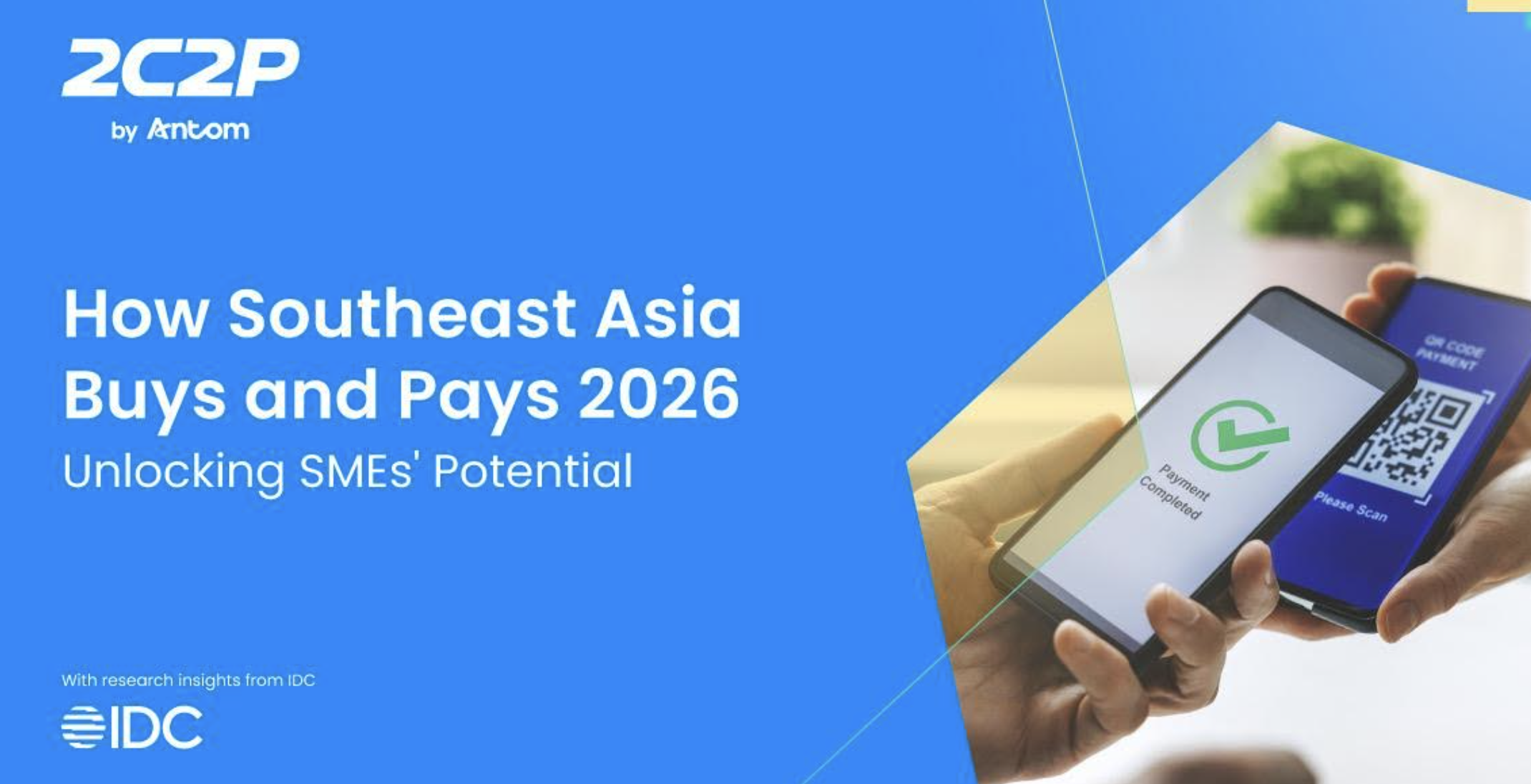
2C2P by Antom, Southeast Asia’s leading full-suite payments platform, released the latest study conducted by market intelligence firm IDC, revealing that the Southeast Asia e-commerce market is on a strong upward trajectory and is projected to become the second fastest-growing e-commerce market in the world with a 13.2% compound annual growth rate (CAGR) from 2024 to 2029, behind only India.
Digital payments continue to dominate e-commerce growth, with Mobile Wallets and Local Payments seeing growing popularity for most of SEA
The independent study commissioned by 2C2P and Antom, “How Southeast Asia Buys and Pays 2026: Unlocking SMEs’ Potential”, shows that SEA’s e-commerce market is projected to increase by 85.4% to hit US$289.8 billion by 2029.
Digital payments are projected to account for 97% of total e-commerce transactions by 2029, up from 89% in 2024. The strongest growth is expected in domestic payments (real-time payments and local bank-based payment schemes) and mobile wallets, particularly in markets such as Indonesia, Thailand, and Vietnam.
Southeast Asia’s digital payments growth across the e-commerce market from 2024 to 2029 is projected across multiple options, including:
- 104% increase in domestic payments (i.e., real-time payment and local bank-based payment schemes) is expected to increase to US$92.0b in 2029 from US$45.1b in 2024. Domestic payments will then be the largest contributor to Southeast Asia’s digital payments sector in 2029, accounting for approximately 32% of the sector, replacing cards.
- 107% boost in mobile wallets with a projection of US$79.0b in 2029 from US$38.2b in 2024. Mobile wallets will account for 27% of the e-commerce market in 2029, up from 24% in 2024.
- 174% growth for Buy Now Pay Later (BNPL), which is expected to record US$18.9b in 2029, from US$6.9b in 2024
With 56% of the region still uncarded, according to the World Bank, these digital payment solutions address structural gaps such as low card penetration, large unbanked populations, and limited access to traditional banking infrastructure.
SMEs expected to contribute 58% of SEA’s e-commerce by 2029, but face digitalization challenges
This latest edition includes a new study on SMEs, a cornerstone of the region’s economic growth and increasingly active in digital commerce, but remains underrepresented in payments and e-commerce analysis. This study surveyed 600 SME respondents across six Southeast Asia markets—Indonesia, Malaysia, the Philippines, Singapore, Thailand, and Vietnam—examining business priorities, payment adoption, and readiness for emerging payment trends.
Across Southeast Asia, the survey finds that 66% of SMEs now sell online, reflecting growing participation in the digital economy. However, uneven digital maturity persists, with one-third of SME respondents still relying heavily on cash in daily operations, even in more advanced markets such as Singapore. This is due to persistent barriers such as integration complexity, fraud concerns, high fees, and infrastructure limitations. These challenges manifest differently across markets—ranging from infrastructure and connectivity gaps in Indonesia and the Philippines, to security and integration concerns in Singapore and Vietnam, and cost and regulatory pressures in Malaysia and Thailand—limiting SMEs’ ability to streamline operations and scale effectively. A majority of 63% also note that their current payment systems require upgrades or replacement to support emerging payment trends.
While only 49% of SME respondents currently engage in cross-border trade, three-quarters express plans to expand internationally within the next two years. This ambition is especially evident in markets such as Indonesia and Thailand, where SMEs are prioritizing expansion into new customer segments.
IDC estimates that enabling broader SME participation in cross-border e-commerce could unlock an additional US$20.8 billion in sales by 2029, representing a 7.1% increase in regional e-commerce value.
Worachat Luxkanalode, Group CEO of 2C2P by Antom, said, “Amidst the continued growth of Southeast Asia’s ecommerce markets, 2C2P by Antom is committed to equipping businesses of all sizes with the knowledge and payment solutions to navigate the complex and fragmented payment landscape of Southeast Asia. Southeast Asia’s businesses, and especially SMEs, are at the heart of the region’s economic growth—contributing more than 50% of GDP in major markets and employing 64.6% of the workforce[1]—but many are still navigating the complexities of digital transformation.”
“As payment ecosystems evolve rapidly across different markets, businesses of all sizes need solutions that can simplify operations, support diverse local payment preferences, and enable them to scale across borders. With our enterprise-grade payments platform, businesses of all sizes can address these challenges through a single API, unlock new opportunities, and fully participate in the region’s prosperous digital economy,” he continued.


Leave a Reply